



Outsourced product development has emerged as an important strategy for businesses looking to stay competitive, innovate faster, and optimise costs. As the global markets continue to evolve, companies of all sizes are leveraging external companies to create effective products, minimise risks, and meet time-to-market goals.
What is Outsourced Product Development?
Outsourced product development is a system where an external agency, team, or professional is hired to take care of some or all the aspects of the product development lifecycle. Companies often outsource product development so that they can use specialised talented professionals and also operational cost and complexities to focus on other important business activities. Outsourcing product development can be found locally as well as globally.
What are the Benefits of Outsourcing Product Development?
-
Access to Local and Global Talent - Outsourcing product development helps companies and business organisations to collaborate with experienced professionals worldwide. Whether it’s AI specialists, UI/UX designers, or software developers, companies gain access to experts they might not have in-house.
-
Cost Reduction - For companies, it is sometimes essential to reduce the cost of product development or not invest in an in-house product development team. This reduces the expenses on hiring specialised professionals, cost spent on workspaces, bonuses, etc.
-
Scale Business - With the help of outsourcing, businesses can scale teams up or down based on project requirements. This flexibility ensures optimal resource allocation without long-term commitments.
-
Faster Time-to-Market - Outsourcing product development can reduce the need to hire and assemble a team. It can save time for other professionals that spend on product development. Last but, not least it can deliver the final product without any delay when a strict schedule is to be followed.
-
Focus on Core Competencies - As the businesses outsource the product development process then it can focus on the core business activity of the business organisation in which it operates as well as other functions such as sales, customer service, etc.
What are Popular Product Development Outsourcing Models?
-
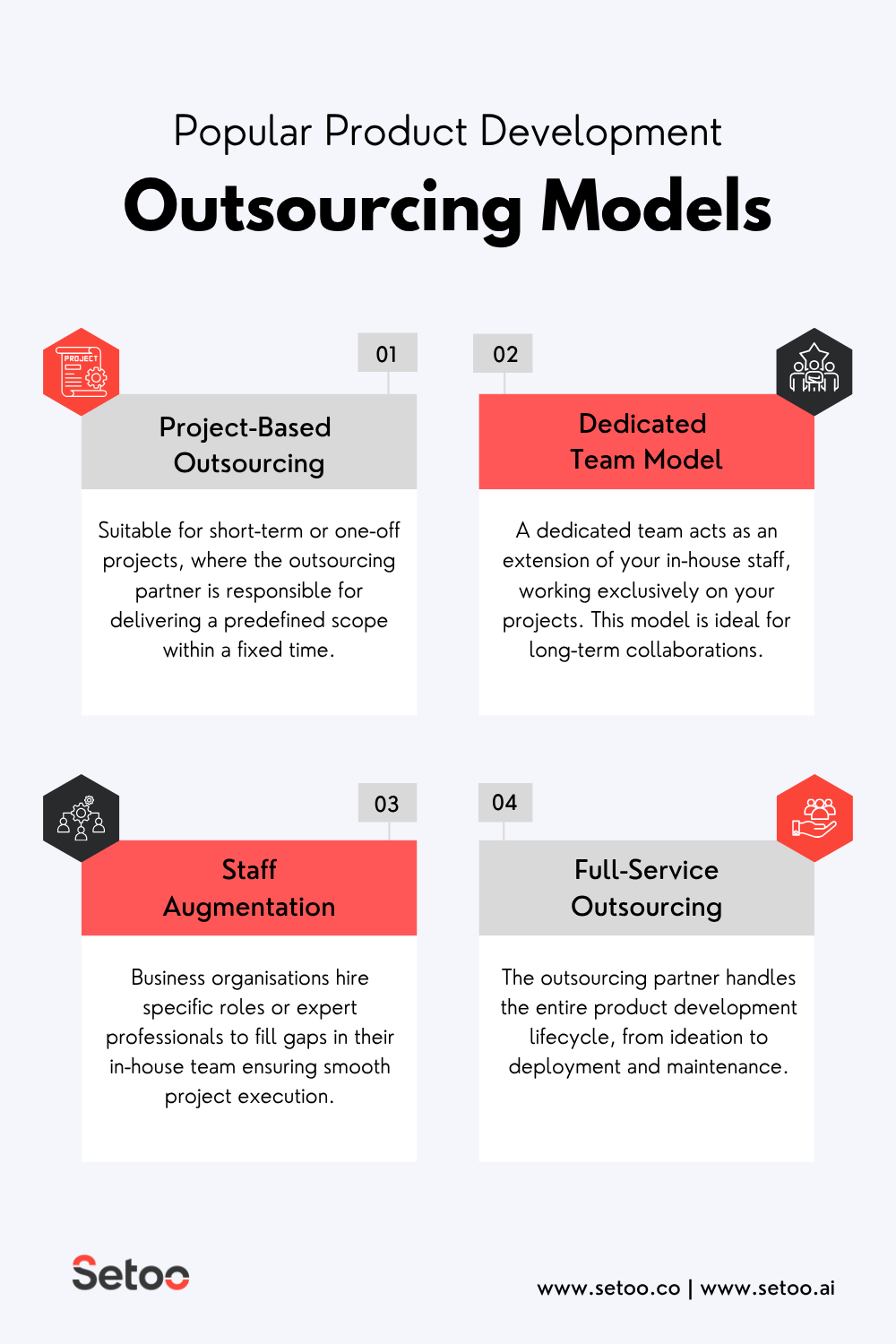
Project-Based Outsourcing - Suitable for short-term or one-off projects, where the outsourcing partner is responsible for delivering a predefined scope within a fixed time.
-
Dedicated Team Model - A dedicated team acts as an extension of your in-house staff, working exclusively on your projects. This model is ideal for long-term collaborations.
-
Staff Augmentation - Business organisations hire specific roles or expert professionals to fill gaps in their in-house team ensuring smooth project execution.
-
Full-Service Outsourcing - The outsourcing partner handles the entire product development lifecycle, from ideation to deployment and maintenance.
What are the Challenges in Outsourcing Product Development?
-
Project Delays - When professionals from different business organisations work together, differences in their work processes, unexpected technical errors, or a lack of project alignment can cause project delays.
-
Communication Barriers - When businesses outsource product development there is a possibility that professionals of collaborating businesses may have communication barriers due to different time zones and cultural differences. It is essential to keep communication clear and documented for future use.
-
Quality Control - It may be difficult to tap into the quality control of products as the product is developed with new outsourcing partners. A lack of oversight can result in subpar deliverables.
-
Dependency on External Teams - Sometimes over-reliance on external partners can lead to operational challenges if the partnership ends abruptly or fails to meet expectations.
Conclusion
Outsourced product development is a powerful strategy for business organisations aiming to innovate efficiently, optimise cost, and access specialised talent. By leveraging outsourcing, companies can accelerate time-to-market, scale operations, and focus on core competencies.
However, it is essential to address challenges such as communicative barriers, quality control, and dependency on external teams through clear processes and effective collaboration. With the right outsourcing model and a reliable partner, businesses can navigate complexities, mitigate risks, and achieve long-term success. As global markets continue to evolve, outsourcing remains a valuable tool for staying competitive and delivering impactful products.
If you have thoughts to share, questions about outsourced product development, or are considering this strategy for your own organization, we’d love to connect. Feel free to comment below or reach out directly to start a conversation about how outsourcing can drive growth for your business.