


About Web Accessibility
Web accessibility can be referred to as a system of building web applications and designing them in a user-friendly way irrespective of their abilities and impairments. The core and the most essential aspect of web accessibility is that it is made for all users so they can easily understand, navigate, and engage with web applications.
This approach aims to make applications accessible and beneficial to a diverse user base, regardless of their conditions, location, or abilities. The objective is to remove barriers so that all users can fully engage with and benefit from the application.
AI’s Role in Web Accessibility
AI (Artificial Intelligence) is a field of computer science that focuses on enabling systems to perform advanced functions similar to human intelligence, such as learning, reasoning, and problem-solving.
AI’s capabilities like NLP, machine learning, computer vision, etc. can be used for accessibility for seamlessness in web applications.
Further, there are a lot of other features powered by AI that can be used in web applications to enhance their accessibility. These are discussed in detail below:
Image Recognition
Images are an essential part of the digital world these days. Images are used in every web application to better represent and communicate thoughts. Image recognition technology is a type of computer vision AI that can instantly describe images along with the automatic alternative text feature.
Neural networks and image algorithms help identify, categorise, and tag objects in images. When web applications find an image, they compare it to millions of indexed images to create descriptions for screen readers. Improved data and algorithms are making these descriptions more accurate.
Facial Recognition
The face recognition feature can be used for the identification of users, authentications, and also for interactions. This feature can be useful for authentication while using web applications instead of only setting passwords, patterns, pins, etc.
The technology measures facial features from different angles and analyzes the captured data from numerous photos of a person's face. In order to ensure that the person engaging is a human, a Captcha test is also done, but if the platform identifies it being human then, there is no need to do a Captcha test.
Speech Recognition
Speech Recognition technology can help users with voice command and recognition however especially useful for users who have motor, cognitive, and learning impairments. It uses NLP and machine learning to convert speech to text by first capturing sound, removing noise, and turning it into readable words.
Speech recognition also enables auto-captioning for videos, benefiting all users but especially hearing-impaired users and the ones with language barriers. This assistive technology allows users to perform tasks such as scheduling appointments, directly sending emails, browsing, calling contacts, etc.
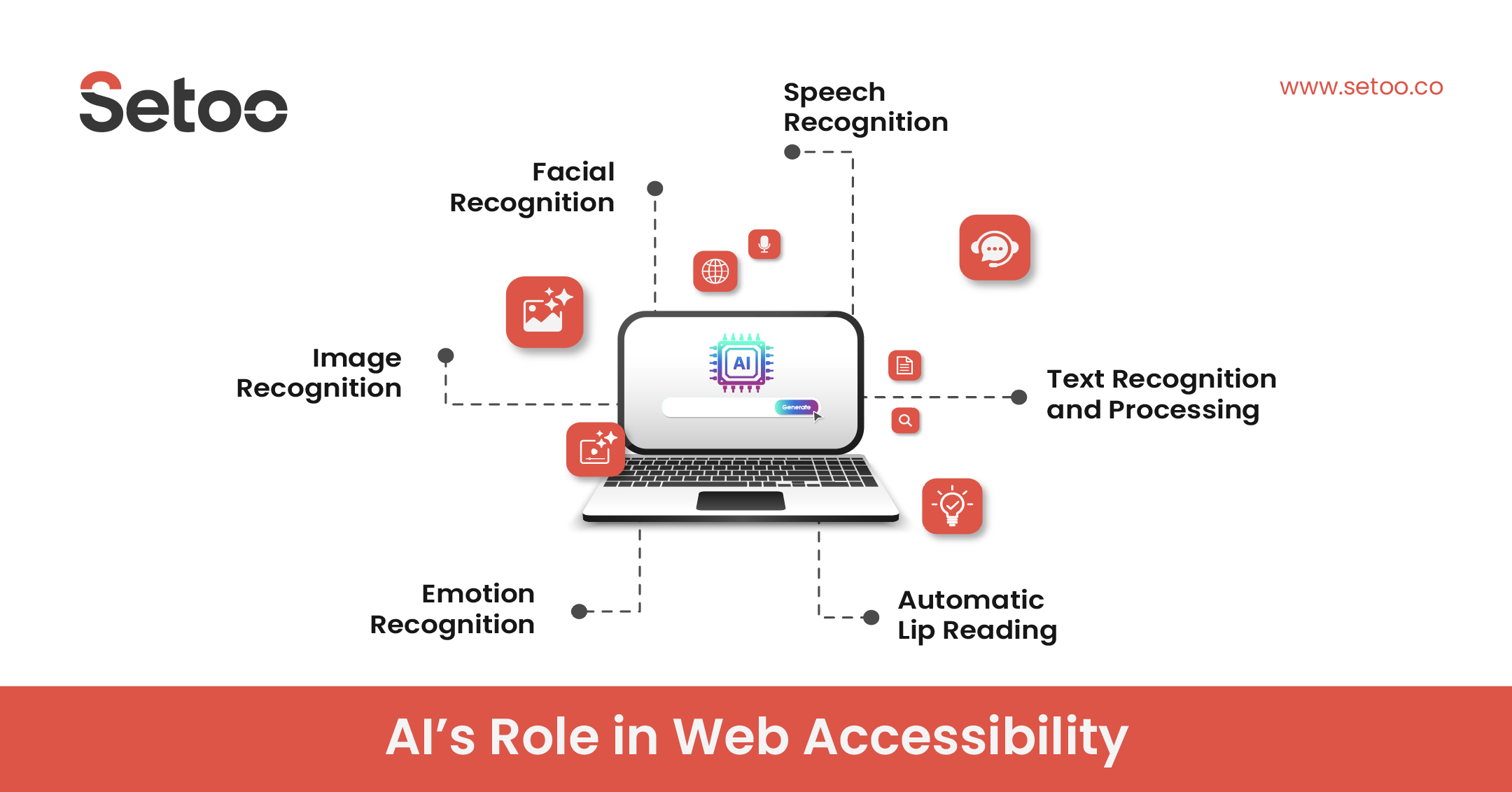
Text Recognition and Processing
The text recognition feature extracts data from images, documents, etc. to convert into readable texts. While text processing summaries the complex content in short summaries in a simpler way. This is a huge step in AI to think and create content that matches the value of the original content.
Automatic Lip Reading
Automatic lip reading (ALR) is a technology that understands spoken words, in a video by analysing the lip movements. It works by using computer vision AI to break down the video frame by frame capturing each lip movement. For every frame, specific features are identified, which helps match the lip movements to sounds or speech units. Finally, these speech units are turned into written captions for the video.
Emotion Recognition
This advanced AI technology analyses the emotions of users by recognising their facial expressions, body language, or voice tone. It detects and interprets emotions in real-time, adopting responses for smoother interactions, and making communications more effective and personalised based on the user’s current mood.
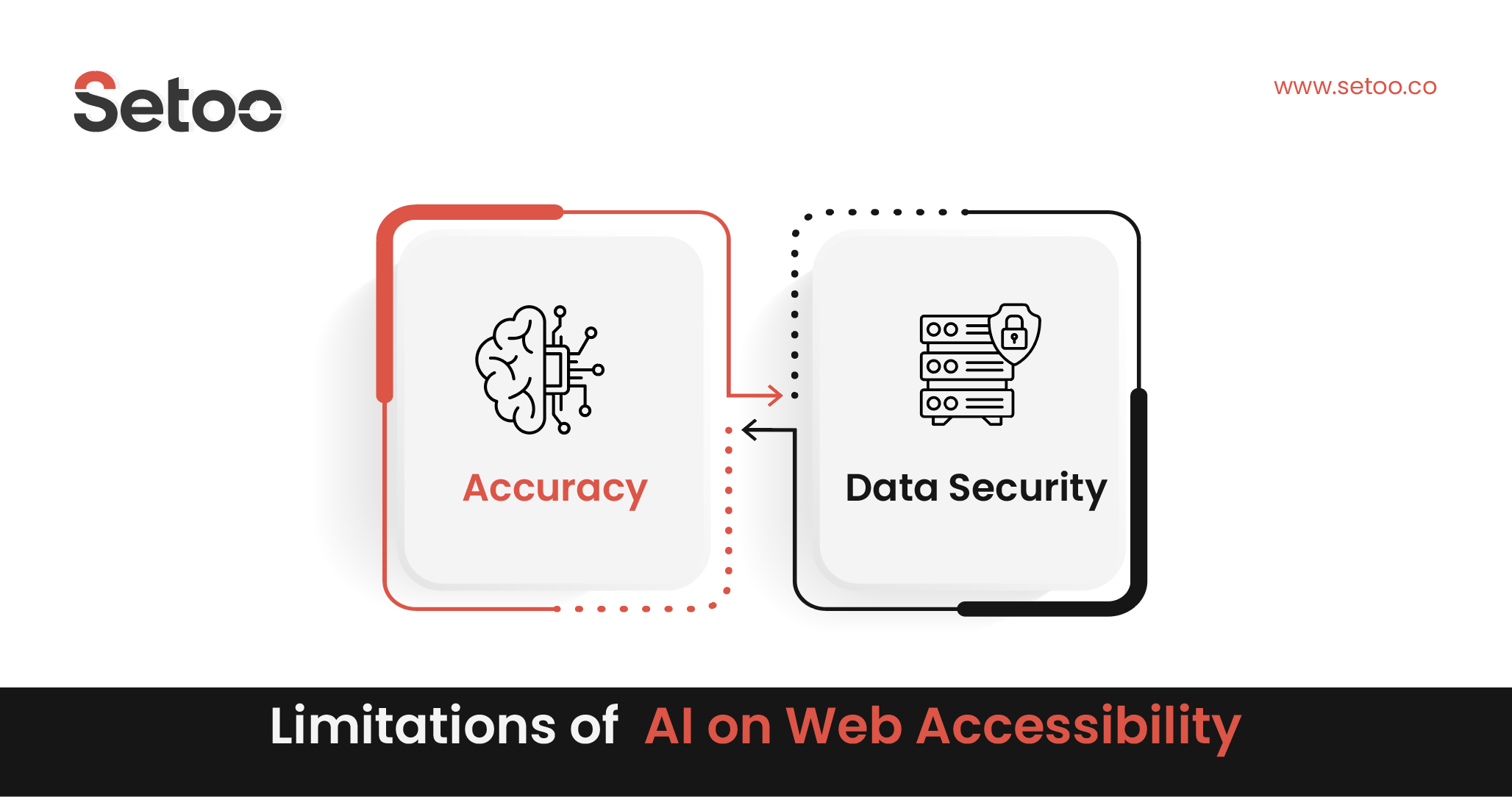
Limitations of AI on Web Accessibility
- Accuracy - The accuracy of AI solutions can sometimes be limited as humans may express certain things in a different way relating to their experiences. These interpretations may not have the same results as the experiences that can be stored or trained.
- Data Security - The security of data of individuals or business organisations can be a threat if the security system is breached. With the increased use of AI tools, the data secured can be at high risk if interlinked with third-party application
Conclusion
AI has increased accessibility in web applications with image, face, speech, text, and emotion recognition features. These features help in better functionality of web applications for users but more especially for specially-abled users. With the changes in technology, AI will improve the functionality of all digital applications.